Announcement: My eQuals has a new website! Learn more about it here.
The modern learner no longer belongs to one institution
For decades, higher education has operated on a fairly simple assumption: a student chooses an institution, completes a qualification, graduates, and moves on. Their relationship with learning – at least formally – was largely defined by a single provider and a single credential.
That assumption is quietly collapsing.
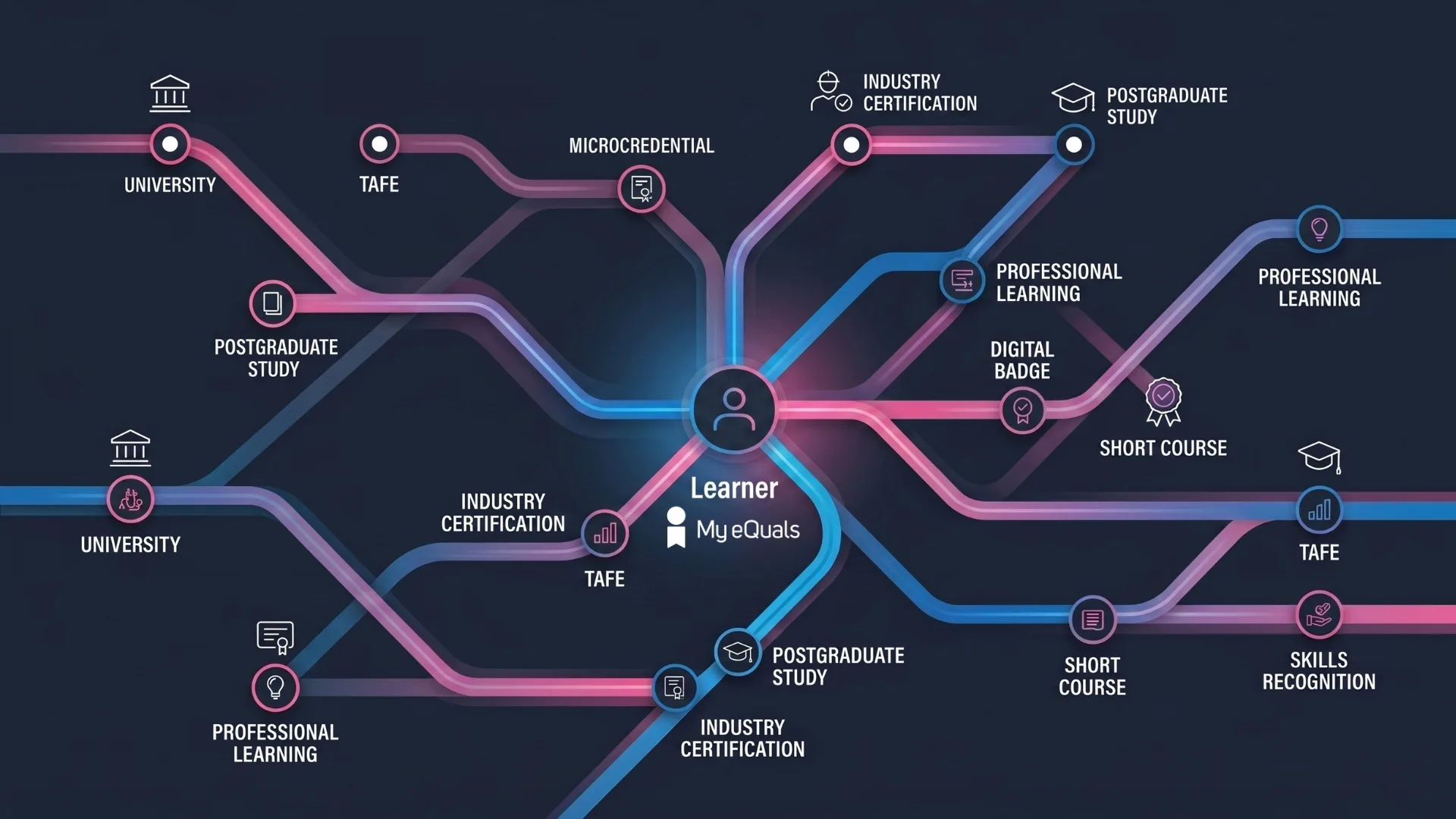
Across Australia and New Zealand, a different kind of learner is emerging. One who collects learning experiences across multiple institutions, across different stages of life, and increasingly across different types of education altogether. A learner who may complete a university degree, stack industry certifications, return for postgraduate study, undertake microcredentials, complete vocational training, and participate in employer-led learning – all within the same lifelong portfolio.
And perhaps most interestingly, the data now proves it.
An analysis of the My eQuals ecosystem between 2018 and 2025 reveals something much larger than platform growth. Yes, the network expanded from fewer than 400,000 learners in 2018 to almost 4 million by 2025. But the most important trend isn’t scale. It’s behaviour.
In 2018, only 2,381 learners on the platform held credentials from more than one issuing institution. By 2025, that figure had surged to more than 222,000 learners. The growth rate of these “multi-issuer” learners has dramatically outpaced overall platform adoption year after year.
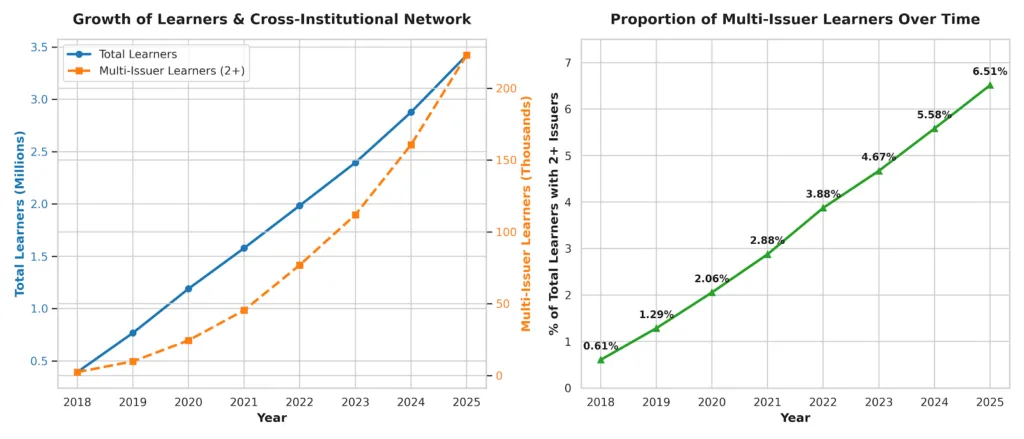
This matters because it tells us something profound about the future of education: students are no longer experiencing learning as a linear journey tied to a single institution. They are assembling education more like a portfolio.
The modern learner has become an aggregator.
This shift has been building quietly in the background for years. Universities have spoken extensively about lifelong learning, but historically the systems supporting tertiary education were never truly designed for it. Student records were institution-centric. Credit recognition processes were fragmented and manual. Credentials were static. Verification was slow. Educational identity effectively “reset” every time a learner crossed institutional boundaries.
What we are now seeing is the emergence of infrastructure capable of supporting mobility rather than resisting it.
That mobility is not theoretical anymore. It is measurable.
The rise in multi-issuer learner profiles strongly suggests that students are actively moving between educational ecosystems: undergraduate study followed by postgraduate specialisation elsewhere; vocational training combined with university qualifications; short-form professional learning layered alongside formal degrees; and increasingly, microcredentials integrated into broader career development pathways.
Importantly, this trend aligns almost perfectly with where policy discussions across the sector are already heading.
The Universities Accord has repeatedly emphasised the need for more flexible, lifelong participation in higher education. Governments are investing in microcredentials and rapid upskilling initiatives. Industry continues to demand shorter learning cycles and more responsive workforce preparation. Universities Australia has explored frameworks for portable microcredentials. Meanwhile, institutions themselves are under pressure to serve learners who no longer fit traditional academic timelines.
In many ways, the sector has been discussing the future learner for years. What the data now shows is that the future learner has already arrived, and they are behaving differently from the systems we originally designed.
One of the most fascinating dimensions of the analysis is that learner complexity itself is increasing. It is no longer just a matter of students holding credentials from two institutions. Increasingly, learners are accumulating records from three, four, or even five separate issuers.
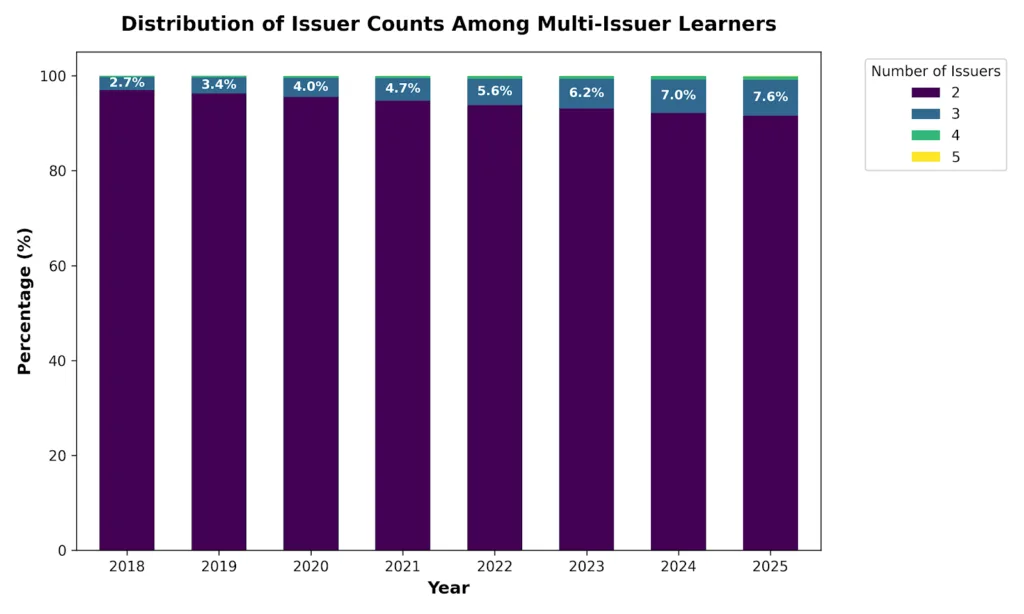
That may sound like a small detail, but it signals a major structural shift.
A learner profile containing credentials from multiple universities, a TAFE, an industry certification provider, and short-form professional learning starts to resemble something entirely different from the traditional academic transcript. It becomes a dynamic skills portfolio. A continuously evolving educational identity.
That evolution raises important questions for institutions.
If learners increasingly move across providers, how should credit recognition evolve? If skills are accumulated incrementally over time, should qualifications remain locked inside rigid program structures? If employers are increasingly verifying capabilities rather than simply degrees, how should credentials themselves be presented?
Perhaps most importantly: who owns the learner relationship in a world where learning is distributed?
Historically, institutions operated as destinations. Increasingly, they may need to think of themselves as nodes within a broader learning network.
This does not diminish the role of universities. In fact, it may elevate it. Trusted institutions become even more valuable in an environment flooded with alternative credentials and fragmented learning experiences. But the nature of institutional participation changes. Universities are no longer simply conferring qualifications at the end of a journey; they are contributing verified learning into a lifelong ecosystem, and that distinction matters.
Because the future of education may not be defined by who awards the biggest qualification, but by who participates most effectively in the learner’s lifelong record.
What platforms like My eQuals reveal is that digital credentials are no longer just administrative tools. They are becoming infrastructure for educational portability. Infrastructure for mobility. Infrastructure for trust.
And perhaps most significantly, infrastructure for learner sovereignty.
For the first time, learners are beginning to accumulate a portable, verifiable, institution-independent educational identity that follows them throughout their careers rather than remaining trapped inside isolated institutional systems.
That changes everything.
The challenge for the sector now is not whether lifelong learning will happen. It already is. The challenge is whether institutions, policy makers, and credentialing systems can adapt quickly enough to support the learner behaviours already emerging around them.
Because the modern student no longer belongs to one institution.
They belong to an ecosystem.